The SolidWorks vs. Inventor question gets asked with the wrong framing. It’s usually phrased as “which is better?” when the useful question is “which is cheaper to live with over five years of marine CAD work?” Those are different questions and they have different answers.
What they do equally well
Both platforms are mature enough that for standard part and assembly work, there’s nothing meaningful to choose between them. Bracket design, structural assemblies, sheet metal, either will do the job. Anyone telling you one is dramatically superior for basic mechanical CAD is advocating, not evaluating.
Where they diverge is at the edges, surface modelling, very large assemblies, sheet metal workflows, and the speed of iterating on parametric trees as a project matures.
Surface modelling
For hull surfaces specifically, neither platform’s native surfacing is ideal. Serious marine work happens in Rhino, sometimes with Grasshopper, and the surfaces get imported to the mechanical CAD platform as reference geometry. That workflow is functionally identical in both SolidWorks and Inventor.
Where Inventor has a mild advantage: its handling of large reference surfaces (full-hull NURBS sets in the 200MB+ range) is slightly more robust in our experience. SolidWorks will handle them, but you pay for it in viewport responsiveness.
Parametric tree discipline
This is where SolidWorks pulls ahead for most marine work. Its feature-tree paradigm, after 25 years of polish, is simply more productive for the kind of deeply parametric assembly work that yacht hardware requires. When a client comes back eight months later and asks to change a mounting pattern on a bracket, the SolidWorks assembly rebuilds cleanly. The same change in a less-carefully-built Inventor assembly sometimes exposes brittleness in the historical tree.
This isn’t a criticism of Inventor, it’s a comment on the muscle memory most marine CAD practitioners have built up over two decades. Inventor can be disciplined into the same robustness; the engineers trained on it often just haven’t been.
Cost over five years
Here’s where it gets interesting. Inventor is bundled into AutoCAD subscriptions at a price point that, for a small consultancy running multiple seats, is 30-40% cheaper than SolidWorks over a five-year licensing window. For a team of three engineers, that’s meaningful money.
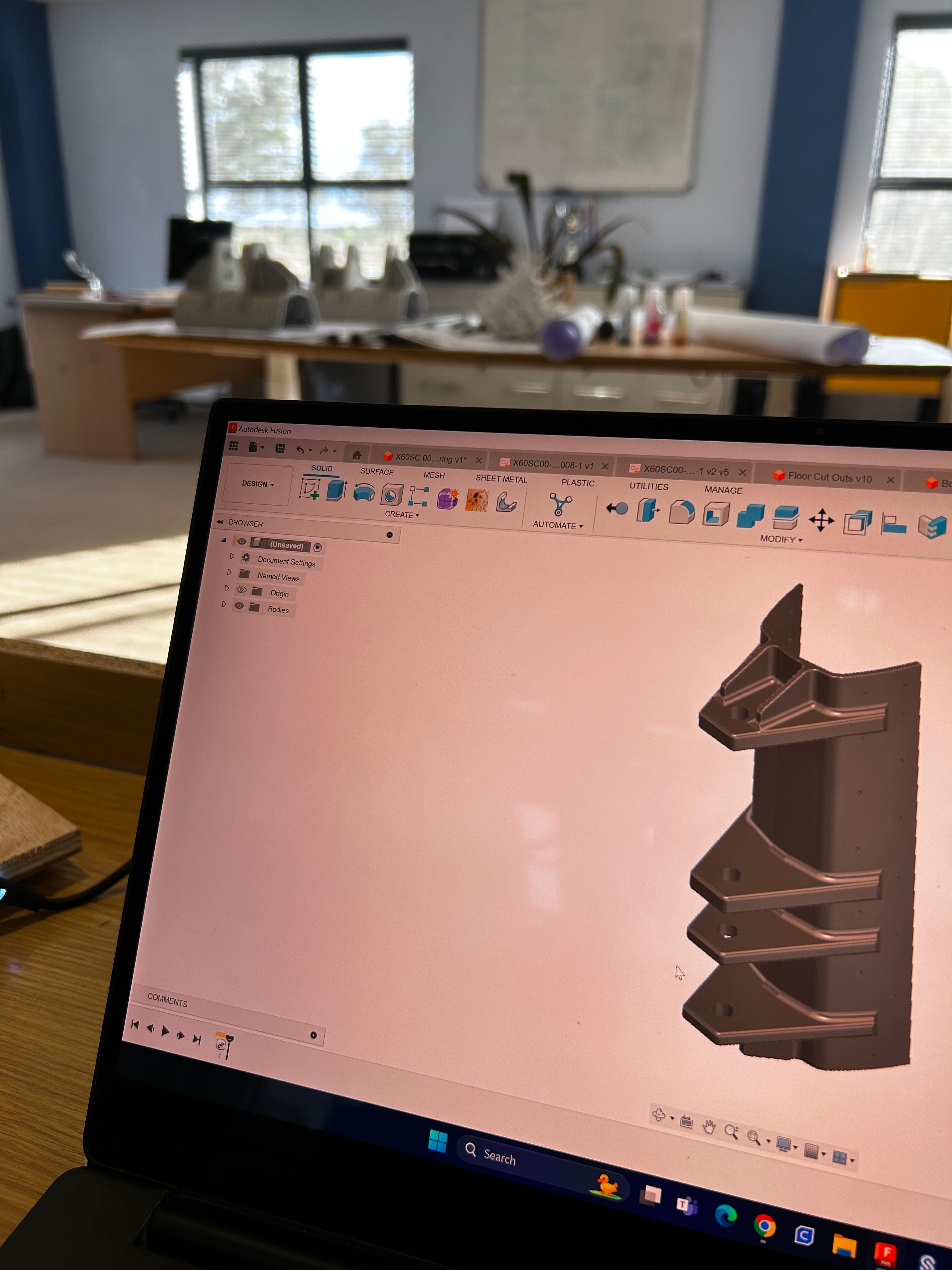
For clients who are already in the Autodesk ecosystem, Revit, AutoCAD, Fusion, Inventor gives free interoperability. SolidWorks plays nicely with everyone, but the cross-platform friction is there.
Our practice
RKT runs both. Most of our yacht-hardware work happens in SolidWorks; most of our industrial project work happens in Inventor and Fusion. We’ve stopped having an opinion on which is “better” and started having opinions on which is right for a specific client ecosystem and a specific engagement length.
The actual recommendation
If you’re a client choosing a CAD platform today for a 5+ year commitment to marine engineering:
- Primarily yacht hardware and precision mechanical work, small team → SolidWorks.
- Industrial engineering, integrated with wider Autodesk ecosystem → Inventor.
- Hybrid practice, cost-conscious → Inventor + Fusion, with Rhino for surface work.
None of these is a wrong answer. The worst answer is indecision, running both at low proficiency across a team, paying for both, and accumulating neither’s muscle memory.